Wednesday, October 24, 2012

The Self-Image of Germany

    Germany and German citizens went through a full gamut of changes in a relatively short period of time.  The citizens of the land were impacted by these events and tended to be hesitant in accepting more change, but still seemed to do so.  As the rise and fall of Hitler is historic across the world, it drastically impacted the German citizens.  The immediate effects of Hitler’s regime instilled political unrest, a desire to belong, and the way Germans view themselves and the world. 

How can we discuss Germany's self-image and historical changes without discussing the rise and fall of Hitler?

    After the fall of Hitler, the Germans had to re-build every aspect of their society.  This included making changes to their past governmental system, but still renewing old leadership.  The Germans re-built their leadership system quickly, and brought back old powers to re-start the economy and political system (Schulze 290).  Though, there was a significant gap in the beliefs of the Soviet Union land which was partitioned into four areas.  The unification of some of these portions of land would inevitably widen the gap between the German split, but was deemed necessary by the United States in order to properly send necessary goods for survival (Schulze 293-294).  Little did the Germans know that this pressure from the US would result in a beneficial ally for the future.  Germany was split due to the conflict associated with all of the rapid changes in leadership and government.  Germans did not want more conflict after the trauma that had just taken place from their leader, therefore seeking independence and an ability to live separately, but peacefully for the citizens in that area.  In hopes of settling conflict, the allies, including the United States, worked to instill democracy.  The push for unification caused more unrest in the German citizens. 
Hindenburg

    The desire to belong roots from the rise of Hitler and the events that occurred after.  Further, Hitler’s pressure to take control caused more hesitation than excitement in the previous leaders of Germany.  Initially, President Hindenburg, the predecessor of Hitler, was not intent on naming Hitler to be the chancellor of Germany (Schulze 242).  Hitler appealed to the President by agreeing to take on a pre-determined set of advisors that would seemingly balance Hitler’s opinions.  Hindenburg found comfort knowing that Hitler approached the chancellor title differently than other candidates, agreeing to maintain a conservative parliament surrounding him (Schulze 243).  Hindenburg avoided giving power to Hitler for as long as he could justify, but eventually granted chancellorship (Schulze 243).  Soon after, Hindenburg would realize the trouble that Germany was facing under new leadership.  As it is commonly known, Hitler led the Nazi party which sought to define one superior race.  With great pressure, the world was turned upside down and a significant amount of loss occurred.  A man who was to lead the country and be trusted by citizens was instead feared.  The shame that many Germans felt.
The mass destruction after the fall of the Berlin Wall. 

    Clearly, with the events and terror that took place under Hitler’s leadership, there is reason for citizens to be hesitant to trust former enemies.  After witnessing genocide, several changes in power, and the division of a land known as home, and for many: displacement, citizens were wise to be weary.  Further, after losing trust in leadership, many Germans felt the need to be independent of the embarrassing actions that took place as a result of the Nazi power.  With a historical political unrest, the citizens divided and simply wanted to survive through to the next days (Schulze 287).  The future was uncertain, and the desire for independence from the Nazi regime was initiated by a desire to feel control for their own selves.  Looking to move forward from the past has caused Germans to be aware of their own actions, which has resulted in a modest self-image.

    After discussing these issues with a friend who immigrated from Germany about eight years ago at the age of 14, I was better able to understand the feelings of the Germans.  He believes that Germany has definitely been cautious to trust other countries, but feels closely attached to the United States, France, and Poland even though they are former enemies.  These countries accepted Germany as an important ally and have given Germany a connection and feeling of safety.  Also, the Germans have worked to create a more unified Europe.  In regards to avoiding conflict, he says that Germans are most adamant to avoid armed conflict.  Most importantly, the Germans see patriotism as a negative action.  It is believe that patriotic people are “mad” because of the influence patriotism had on the Nazi party.  I feel as though my conversation with my friend clarified many of the historical events, especially because he learned about them from the US and Germany educational perspectives.

Michael, Myself, and Jan.  Jan moved here from Germany when he was 14.  We have been friends since my freshman year of high school, so, about 7 years.  Jan is super tall (6'7?), so every picture we took in high school looked like this.  He's also an incredible soccer player.
The Germans prefer to handle disputes civilly, rather than with weapons.

Word Count: 789 + captions

Monday, October 1, 2012

Unifying Germany...in an Artistic Way.


To set the scene: 
As you can see, pre-unification of Germany, the map is somewhat of a "hot mess" (for lack of a better term).  Sporadic chunks of land are ruled and occupied by various groups.

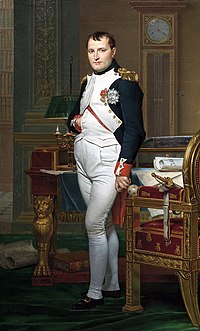
       The Germans had several challenges as they traveled the rocky road of unification.  While divided into many groups, the Germans did not have a strong central force to keep unified, nor did they always want to be.  Further, the German land had been taken over by forces, including the French under Napoleon’s rule.  While Napoleon caused a significant amount of trouble for the surrounding countries and land, without him, Germany would not likely be the country they are today. 

(Napoleon, pictured above, was the initiating force for war and political unrest across Europe.) 
    The birth of Germany can be attributed to many actions from surrounding powers and people.  Aside from Napoleon’s impact, there was a great amount of French influence while Louis XIV tried to take over a great amount of land that would expand his rule (71).  While the French had a presence that impacted many of the actions that Germans took, the Germans seemed to bond together and unify due to the actions that the French were taking.  Though, the Germans did not always want to be in a unified country because it felt restrictive or as if the people could be uprooted against their wishes in a free land.

The Liberal Arts are demonstrated through the German's love and general unification through art. 
    I found the initial unification of Germany inspiring.  Hagen mentions on page 91 that the “German nation was born in the minds of the intelligentsia as a cultural entity without direct ties to politics.”  This shows that the underlying bond of the Germans came from what draws people together: commonalities.  Without a great amount of research, my observations show that politics tend to tear more people and groups apart than unify.  Further, beyond the sciences and math, I see the arts as an exemplary place to demonstrate intelligence.  This, from a liberal arts student, may not come as a surprise.  The arts have an amazing way of expressing knowledge, opinions, and inspiring conversation.  And, Martin Luther was a huge proponent of the Liberal Arts in education, providing an even more solid foundation for the Germans to use their skills.  Sometimes, this spark of attention and opinion is all that is needed to bring a group together.  This can be seen throughout Germany’s story of unification.  Later, it is said in the Hagen text that the Germans were “powerless, but intellectually supreme” (91).  Without a grand political presence or military set-up, the Germans had the knowledge to remain a competitive presence on the map.  I believe that by developing their unification in an artistic, rather than power-based or political fashion, Germany set a standard of how they would be perceived in the future.  I also believe that this has impacted Germany today as being rich in culture through art, architecture, food, and spirit.  I am certain that these attributes will come to life in our travel throughout Germany. 


Our good friend Martin Luther peeks back into this issue through his influence of the Liberal Arts, and how the arts influenced many German people to speak their opinions.  

Many influential German artists from various times included (L-R) Johann Wolfgang, Ludwig van Beethoven, and Immanuel Kant. 
    On page 107 of Hagen’s text, we read that Central Europe was fragmented, but held together by the Deutscher Bund, or the German Confederation.  This unification was based on a “secular descendent of the Holy Roman Empire”.  That means that the unification was based off of a religious intention or group.  Though, while bringing people together, the German people were given opportunities to develop their own opinions.  While remaining an artistically based group, the Germans found their voice through public opinion.  The liberal opinions of the residents became organized into governmental representatives that later were able to spread the peoples’ opinions.  Hagen discusses on page 118 that, “Political unrest mounted again in Germany...After the events in 1830 the authorities managed to gain the upper hand again, but the mere fact that most German states now had representative assemblies whose liberal delegates could speak and publish freely without fear of punishment made it impossible to control public opinion.”  Hagen continues on the same page mentioning that liberal opposition gained vast numbers of new supporters.  The growing support brought Germany together and provided another reason to unify with a common goal and intention. 

    While I find it inspiring how and why the German lands united, I also see the flaws of how the group came together.  In the end, the Germans officially unified due to the need for a political presence.  The unification allowed for Germans to have a voice in what they wanted and, quite frankly, living in an oppressed society would not last for those who had a voice to be heard.  


Word Count: 704 + annotations.

All images taken from google.images.com